

A research question asks what a study will investigate. A hypothesis states the result the researcher expects to observe. Although the two concepts are related, they are not interchangeable, and many valid studies use research questions without hypotheses.
This guide explains the distinction, shows how each element fits into a research design, and provides examples for quantitative, qualitative, and mixed-methods projects.
Research question vs hypothesis: the essential difference
A research question defines the problem, phenomenon, or relationship a study will examine. It is written as a question and guides decisions about data, participants, methods, and analysis.
A hypothesis is a specific, testable prediction about the expected answer. It is normally written as a statement and evaluated using empirical evidence.
| Feature | Research question | Hypothesis |
|---|---|---|
| Purpose | Identifies what the study seeks to discover | Predicts an expected result or relationship |
| Typical form | Interrogative sentence | Declarative statement |
| Expected answer | Open when the study begins | Predicted before data analysis |
| Common use | Quantitative, qualitative, and mixed-methods research | Primarily quantitative and confirmatory research |
| Evaluation | Answered through evidence and analysis | Supported or not supported by evidence |
| Example | How does sleep duration relate to exam performance? | Students who sleep longer will earn higher exam scores. |
The simplest distinction is that a research question asks, whereas a hypothesis predicts.
A strong version of either must also be focused, researchable, and consistent with the study design.
What is a research question?
A research question translates a broad topic into a problem that can be investigated. “Student health,” for example, is only a topic. “How is weekly physical activity associated with self-reported stress among first-year university students?” is a research question.
A well-defined research question usually identifies:
- the population, setting, or material being studied;
- the central phenomenon, variables, or concepts;
- the relationship, experience, difference, or process of interest;
- the scope or context within which the investigation will occur.
Common types of research questions
Research questions can serve different purposes. Their wording should reflect the evidence and analysis needed to answer them.
- Descriptive: What proportion of remote employees report working outside standard hours?
- Comparative: Do stress scores differ between remote and office-based employees?
- Relational: What is the association between after-hours email use and employee stress?
- Causal: Does limiting after-hours email reduce employee stress?
- Exploratory: How do remote employees describe the boundary between work and personal time?
Causal questions require especially careful designs. Finding that two variables are associated does not, by itself, establish that one caused the other.
What is a research hypothesis?
A research hypothesis is a reasoned prediction that can be assessed with observable data. It often specifies a relationship or difference between variables and may identify the expected direction of that effect.
Consider this pair:
- Research question: Is weekly study time associated with final exam scores among first-year biology students?
- Hypothesis: First-year biology students who study more hours per week will obtain higher final exam scores.
The question identifies what will be examined. The hypothesis commits to an expected pattern. That prediction should be grounded in theory, previous evidence, or a clearly explained line of reasoning rather than invented after the results are known.
A hypothesis is provisional: it is an expectation to be evaluated, not a fact established in advance.
Directional and non-directional hypotheses
A directional hypothesis predicts how variables will relate. For example: “Participants receiving reminder messages will complete more training modules than participants receiving no reminders.”
A non-directional hypothesis predicts a difference or association without stating its direction: “Module completion will differ between participants who receive reminder messages and those who do not.”
Directional wording is appropriate when there is a defensible reason to expect a particular result. A non-directional statement may be more suitable when existing evidence is limited or inconsistent.
Null and alternative hypotheses
In statistical hypothesis testing, researchers often distinguish between two formal statements:
- Null hypothesis (H0): proposes no difference, effect, or association in the population.
- Alternative hypothesis (H1 or HA): proposes that a difference, effect, or association exists.
For example, a null hypothesis might state that the mean exam scores of two teaching groups are equal, while the alternative states that the means differ. These statistical hypotheses are related to, but not always worded exactly like, the substantive prediction described in an introduction.
Statistical analysis does not usually “prove” a hypothesis. Evidence may support a prediction or justify rejecting a specified null hypothesis, but conclusions remain subject to uncertainty, assumptions, bias, measurement quality, and the limits of the design.
Do all studies need both?
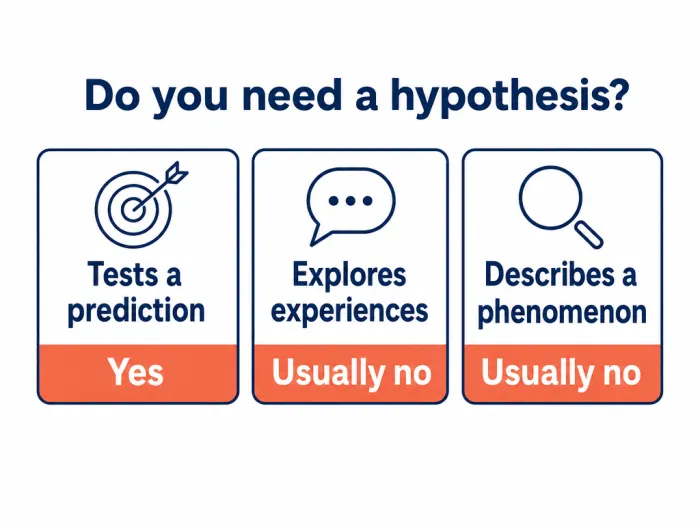
No. Most studies need a clear question, objective, or problem statement, but not every study needs a formal hypothesis.
Hypotheses are especially common in quantitative studies designed to test expected relationships, group differences, or intervention effects. They may be unnecessary when a study is:
- exploring a poorly understood topic;
- describing a population or phenomenon;
- examining participants’ experiences through qualitative interviews;
- developing a theory rather than testing an existing prediction;
- conducting an initial feasibility or methodological investigation.
A qualitative interview study might ask: “How do family caregivers experience communication with hospital staff?” Imposing a predictive hypothesis could conflict with the study’s exploratory purpose.
Requirements also vary across disciplines, journals, supervisors, and research traditions. The appropriate choice is the one that matches the study’s purpose and analytical approach.
A clear research question is broadly necessary; a formal hypothesis is only necessary when the study is designed to test a prediction.
How questions, hypotheses, aims, and objectives connect
These terms describe related parts of a project, but each has a distinct role:
- Aim: the broad purpose of the study.
- Objective: a concrete action the researcher will complete.
- Research question: what the study seeks to answer.
- Hypothesis: the result expected before testing.
Here is how they can align within one project:
- Aim: To examine whether structured study planning is related to academic performance.
- Objective: To compare exam scores among students who use a weekly study plan and those who do not.
- Research question: Do exam scores differ between students who use a weekly study plan and students who do not?
- Hypothesis: Students who use a weekly study plan will achieve higher exam scores.
The population, concepts, and comparison remain consistent across all four elements. This alignment helps prevent a common methodological problem: collecting data that cannot answer the stated question.
These decisions belong to the broader field of research methods.
Examples across different study designs
Experimental study
Question: Does a 10-minute retrieval-practice exercise improve vocabulary retention compared with rereading?
Hypothesis: Learners assigned to retrieval practice will retain more vocabulary after one week than learners assigned to rereading.
Observational study
Question: Is daily commuting time associated with job satisfaction among urban employees?
Hypothesis: Longer daily commuting time will be associated with lower job satisfaction.
Because this design is observational, the wording predicts an association rather than claiming that commuting time causes lower satisfaction.
Qualitative study
Question: How do new teachers describe their experiences of mentoring during their first year?
Hypothesis: A formal hypothesis may not be needed because the purpose is to understand experiences rather than test a predetermined relationship.
Mixed-methods study
Question: Does mentoring relate to first-year teacher retention, and how do teachers explain the ways mentoring influenced their decision to stay or leave?
Hypothesis: Teachers who receive regular mentoring will have higher retention rates than teachers who do not.
The hypothesis addresses the quantitative component, while the broader question also covers the qualitative component.
How to turn a research question into a hypothesis
Not every question should become a hypothesis. If prediction is appropriate, use the following process:
- Identify the population. Specify who or what the prediction concerns.
- Identify the main variables. Clarify what will be measured, compared, or manipulated.
- Define the expected relationship. Decide whether you expect a difference, association, or effect.
- Choose directional wording when justified. State “higher,” “lower,” “positive,” or “negative” only when there is a sound basis.
- Check testability. Each concept must be observable or measurable using the proposed data.
- Match the design. Do not make a causal prediction when the design can establish only an association.
For example, “How does social media affect young people?” is too broad and assumes an effect. A more precise question would be: “Is evening social media use associated with sleep duration among students aged 18 to 22?”
A corresponding hypothesis would be: “More evening social media use will be associated with shorter sleep duration among students aged 18 to 22.”
The population, variables, expected relationship, and research design should remain consistent when a question is converted into a hypothesis.

Checklist for choosing the right format
- Is the statement written as a genuine question or as a prediction?
- Does it identify a defined population, context, or body of material?
- Are the central variables or concepts clear?
- Can the question be answered with data you can realistically obtain?
- Can the hypothesis be supported or not supported by observable evidence?
- Does the wording match a descriptive, relational, comparative, or causal design?
- Is a directional prediction justified by theory or previous evidence?
- Have you avoided claiming causation from an observational design?
- Are the question, methods, analysis, and interpretation aligned?
- Have you checked the conventions required by your discipline or institution?
Common mistakes to avoid
Writing a question that already assumes the answer
“Why does remote work reduce productivity?” assumes that productivity declines. Unless that effect is already established and the study specifically investigates its mechanisms, use neutral wording such as: “How is remote work arrangement associated with employee productivity?”
Using vague or unmeasurable concepts
A prediction such as “Technology makes education better” does not define technology, education, or “better.” Name the intervention, outcome, population, and relevant period.
Confusing a prediction with an established fact
A hypothesis is provisional. Present it as an expectation to be evaluated, not as a conclusion already demonstrated by the study.
Changing the hypothesis after seeing the results
Results can inspire new hypotheses, but those should be identified as exploratory and tested with new evidence where possible. Presenting an after-the-fact explanation as an original prediction can make the evidence appear stronger than it is.
Using causal language without a causal design
Words such as “causes,” “leads to,” and “results in” require a design capable of supporting causal inference. For many observational projects, “is associated with” or “is related to” is more accurate.
A practical rule to remember
The research question opens the investigation; the hypothesis predicts where it may lead.
Use a question to define what you need to learn. Add a hypothesis when theory, previous evidence, and the research design justify a prediction that can be tested.
Before finalizing either one, confirm that its wording aligns with the population, variables, data, methods, analysis, and interpretation.
Mini FAQ
Can a paper have several research questions?
Yes. A project may include a main question and several subquestions. Each one should contribute to the same overall purpose and be answerable within the available time, data, and scope.
Can one research question have multiple hypotheses?
Yes. A broad question may generate separate hypotheses for different outcomes, groups, variables, or mechanisms. Each hypothesis should be stated clearly and linked to an appropriate analysis.
Should a hypothesis be written in the future tense?
There is no universal rule. “Students receiving feedback will improve more” and “Students receiving feedback improve more” can both be understood. Follow the style expected in your field and use it consistently.
What happens if the data do not support the hypothesis?
An unsupported hypothesis is not automatically a failed study. The result may challenge the original explanation, reveal limitations, or suggest a new question. It should be reported accurately rather than reframed to match the prediction.
Is a hypothesis the same as a thesis statement?
No. A hypothesis is an empirically testable prediction. A thesis statement presents the central argument or position of a paper and may be used in analytical work that does not test a statistical prediction.
Which should be written first?
Usually, begin with the research problem and research question. Review the relevant concepts and evidence, then formulate a hypothesis if the design calls for a testable prediction.