

A literature review matrix turns a collection of papers into a structured body of evidence. Instead of relying on separate notes, you record comparable information from each source in one place, making it easier to identify patterns, disagreements, research gaps, and methodological differences.
This guide explains how to build a literature review matrix for a research project, select useful columns, extract evidence consistently, and move from note-taking to a defensible synthesis.
What Is a Literature Review Matrix?
A literature review matrix is a table used to compare sources according to a consistent set of criteria. Each row usually represents one source, while the columns capture information such as the research question, theoretical framework, methods, findings, limitations, and relevance to your project.
A literature review matrix is an analytical workspace: it supports critical reading and synthesis, but it does not replace them.
A well-designed matrix helps you:
- compare studies without repeatedly reopening every paper;
- separate authors’ conclusions from your own interpretation;
- track quotations, page numbers, and bibliographic details;
- detect recurring themes and conflicting results;
- identify underexplored populations, settings, methods, or variables;
- organize the evidence before drafting your review.
A matrix is particularly useful when a project includes many sources or combines evidence from different disciplines. An understanding of interdisciplinary sciences can also help researchers account for differences in terminology and research traditions.
Define the Purpose of the Matrix Before Creating It
Do not begin by creating dozens of columns. First decide what the review must explain. A matrix designed to compare statistical methods will look different from one examining theoretical debates, historical developments, or policy outcomes.
Write a focused review question
State the question in one sentence. If it remains too broad, break it into components such as population, phenomenon, context, intervention, outcome, period, or method. Not every component will apply to every discipline.
Instead of asking, “What does the literature say about remote work?”, a project might ask: “How has remote work been associated with employee collaboration in knowledge-intensive organizations since 2020?” This sharper question indicates which details the matrix should capture.
The review question should determine the contents of the matrix, rather than being adjusted to fit the information that happens to be easy to collect.
Decide what counts as relevant evidence
Record basic inclusion and exclusion criteria before screening sources. These may concern publication dates, languages, study designs, geographic settings, populations, document types, or subject areas. Keep the rules aligned with the research question rather than choosing them for convenience.
Early source selection can be strengthened by a consistent approach to choosing research resources.
Choose the Right Columns for Your Research Project
A useful matrix contains enough detail to support comparison but not so much that extraction becomes unmanageable. Start with a compact set of core columns and add specialized fields only when they serve the review question.
| Column | What to record | Why it matters |
|---|---|---|
| Full citation | Author, year, title, publication, DOI, or stable URL | Supports accurate referencing and source retrieval |
| Research aim | The question, objective, or hypothesis addressed | Shows whether the study is relevant to your review |
| Context | Country, setting, discipline, period, or institutional environment | Helps assess whether findings transfer across settings |
| Data or sample | Participants, documents, datasets, cases, and sample size where applicable | Reveals the evidence on which conclusions depend |
| Method | Study design, collection procedure, analytical technique, or model | Allows methodological comparison |
| Theory or concepts | Frameworks, definitions, and central constructs | Exposes conceptual similarities and differences |
| Main findings | A concise and neutral summary of the results | Provides the basis for synthesis |
| Limitations | Limitations acknowledged by the authors and relevant concerns you identify | Prevents uncritical use of conclusions |
| Key evidence | Quotation, statistic, table reference, or result with a page number | Makes important claims traceable |
| Relevance | How the source informs your question, argument, or research design | Connects extraction to the purpose of the review |
| Theme codes | Short, consistent labels assigned during analysis | Supports grouping across sources |
Some projects need additional columns for variables, effect measures, software, funding, conflicts of interest, policy implications, or quality appraisal. Add them only if you expect to compare that information across multiple sources.
Build the Literature Review Matrix Step by Step
1. Select a suitable tool
A spreadsheet is sufficient for many projects because it supports filtering, sorting, comments, and controlled labels. A word-processing table may work for a small review, while reference managers, qualitative analysis programs, or review-management platforms can help with larger projects.
Choose the simplest tool that meets the project’s needs. Clear categories and consistent notes matter more than sophisticated software.
2. Create one row per source
Give every source a unique identifier. Enter the full citation immediately rather than planning to reconstruct it later. If several publications report the same study, note their relationship so they are not mistakenly treated as independent evidence.
3. Test the matrix on a small sample
Pilot the columns with three to five varied sources. This often reveals duplicated fields, ambiguous headings, or information that cannot be extracted consistently. Revise the structure before processing the full source set.
4. Define each column
Create a brief extraction guide explaining what belongs in every field. For example, specify whether “limitations” includes only those stated by the authors or also your own appraisal. Definitions become especially important when several people contribute to the review.
5. Extract information consistently
Use concise phrases rather than copying entire passages. Preserve exact wording only when it is analytically important, place it in quotation marks, and record the page or section. Mark absent information as “not reported” rather than making an assumption.
6. Review entries as the matrix grows
After every group of papers, inspect the table for inconsistent terminology and overly long notes. Merge labels that describe the same concept, but do not erase meaningful distinctions between authors, methods, or disciplines.

Use the Matrix to Evaluate Evidence, Not Just Summarize It
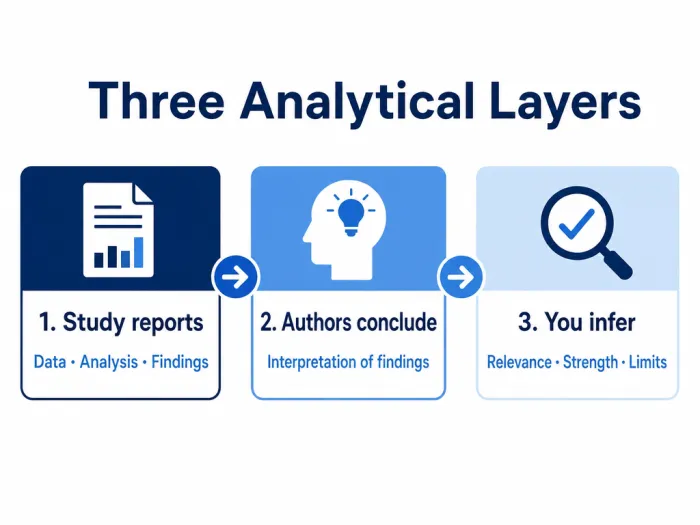
A matrix becomes valuable when it supports critical comparison. For every source, distinguish among three analytical layers:
- What the study reports: its data, analysis, and stated findings.
- What the authors conclude: their interpretation of those findings.
- What you infer: your assessment of relevance, strength, limitations, or relationships with other studies.
Keeping reported findings, author interpretations, and your own evaluation separate reduces the risk of misrepresenting the evidence.
Compare studies on appropriate terms
Two papers addressing a similar topic may use different definitions, populations, time periods, or outcome measures. Their results should not be treated as directly comparable until those differences have been examined.
Critical appraisal should also fit the study design. Questions suitable for an experiment may not apply to an ethnography, theoretical article, simulation, or archival study. These distinctions are central to the broader field of research methods.
Turn the Completed Matrix Into a Literature Synthesis
The final review should usually be organized around ideas, themes, methods, or debates rather than presented as a sequence of source summaries. Use filters or theme codes to group rows and ask comparative questions.
Look for patterns
- Which findings recur across several studies?
- Do similar methods produce similar conclusions?
- Are results different across countries, populations, or periods?
- Which theories dominate the field?
- Which concepts are defined inconsistently?
Investigate disagreements
Conflicting results are not merely problems to remove. They may reflect different samples, measurement choices, assumptions, models, or contexts. Use the matrix to test plausible explanations before describing a debate.
Identify meaningful research gaps
A research gap is not simply a topic with few papers. It should be relevant to the research question and consequential for knowledge or practice. Examples include an overlooked population, an untested assumption, inconsistent measurement, limited geographic coverage, or a lack of evidence connecting two established findings.
Draft by claim, not by paper
For each section of the review, write a provisional claim and identify the rows that support, qualify, or contradict it. A strong paragraph can then compare several sources, explain relevant differences, and state what the combined evidence permits you to conclude.
A literature synthesis should explain relationships among studies rather than reproduce the order in which they were read.
Common Literature Review Matrix Mistakes
One common mistake is treating the matrix as a storage archive. Collecting extensive notes does not automatically produce synthesis. Other problems include changing criteria midway without documenting the change, copying abstracts instead of reading full texts, and recording conclusions without their methodological context.
Creating too many columns
An oversized matrix can make extraction slow and inconsistent. Remove fields that do not contribute directly to comparison, appraisal, or the review question.
Copying text without analysis
Large copied passages make patterns harder to detect. Most cells should contain concise paraphrases, while exact quotations should be limited to definitions, theoretical statements, or wording that requires precise analysis.
Changing labels without standardization
Using several labels for the same idea prevents reliable filtering. Maintain a controlled list of theme codes, define each code, and document any changes made during the project.
Ignoring context and methodology
Findings cannot be interpreted responsibly without knowing how they were produced. Record the study design, sample, setting, period, and analytical approach alongside the results.
Literature Review Matrix Checklist
Before drafting the review, confirm that:
- the review question is specific enough to guide extraction;
- inclusion and exclusion criteria are recorded;
- every source has a complete citation and unique identifier;
- column headings have clear definitions;
- the matrix was tested on a small group of varied sources;
- direct quotations include page or section references;
- missing information is marked as “not reported”;
- author conclusions are separated from your evaluation;
- methodological and contextual differences are visible;
- theme labels are applied consistently;
- important claims can be traced back to their sources;
- the draft plan groups evidence by issue, theme, method, or debate rather than by author.
Mini FAQ
How many columns should a literature review matrix contain?
There is no universal number. Use the smallest set that captures the evidence needed to answer your review question. A focused project may need eight to twelve columns, while a complex review may require more. Pilot testing is the best way to decide.
Should each row represent a paper or a theme?
For initial extraction, one source per row is usually the clearest structure. During synthesis, you can create a second thematic matrix in which rows represent themes and columns show supporting, conflicting, and missing evidence.
Can I copy information from an abstract?
Abstracts are useful for initial screening, but they rarely contain enough methodological detail for dependable extraction. Use the full text whenever possible and clearly mark entries based only on an abstract.
Should I include quotations in the matrix?
Include selected quotations when exact wording matters, particularly for definitions or theoretical claims. Most cells should contain concise paraphrases. Always distinguish quotations from paraphrases and record a page or section reference.
When should I update the matrix?
Update it whenever the source set, research question, or coding framework changes. For a long project, schedule a final search and matrix update before completing the review so the evidence base remains current within the limits of your protocol.
Can several researchers work in the same matrix?
Yes. Agree on column definitions, labels, and the handling of missing information first. Pilot the process on the same sources, compare entries, resolve differences, and document changes to the extraction rules.