

Reproducibility and replicability both help researchers test the reliability of scientific findings, but they do not describe the same process. Under the convention used in this article, reproducibility means obtaining the reported results again with the original data and analytical procedures. Replicability means conducting a new study with new data and reaching a result consistent with the original finding.
In one sentence: reproducibility checks whether the original analysis can be rerun; replicability checks whether the scientific finding holds when the study is repeated with new evidence.
Reproducibility vs replicability at a glance
| Question | Reproducibility | Replicability |
|---|---|---|
| What is being tested? | The original analysis and reported results | The underlying scientific claim |
| What data are used? | The original data | New, independently collected data |
| What methods are used? | The original code, workflow or analytical procedure | A new implementation of the study, usually based on the original design |
| Must the numbers be identical? | Often yes, apart from documented numerical variation | No; the results should be scientifically consistent, not necessarily identical |
| Common obstacle | Missing code, data, dependencies or instructions | Sampling variation, contextual differences or an unstable effect |
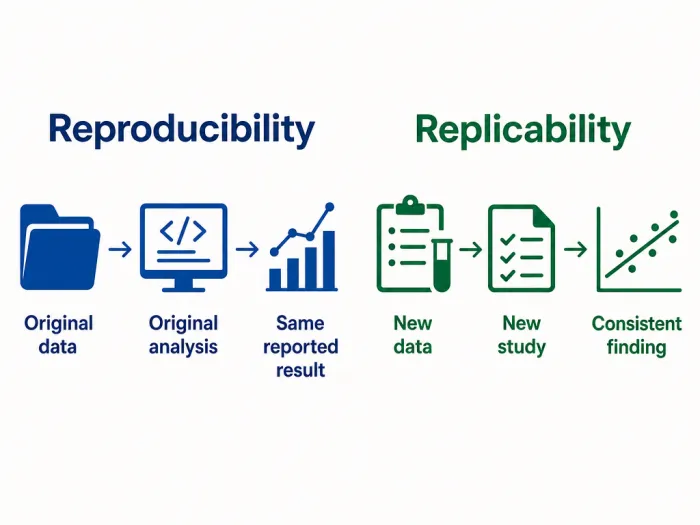
What does reproducibility mean?
A result is reproducible when another researcher can use the original study’s data and analytical procedures to regenerate its reported findings. In a computational project, this may involve running the same scripts against the same input files and recovering the same tables, figures or model estimates.
Reproducibility therefore evaluates the traceability and technical integrity of the research workflow. It can reveal whether:
- the available data correspond to the data described in the study;
- the analysis code runs successfully;
- data-cleaning and exclusion decisions are documented;
- software versions and dependencies are specified;
- the code produces the reported statistics and visualizations;
- random processes are controlled or adequately documented.
A simple reproducibility example
Suppose a paper reports a relationship between two economic indicators. The authors publish the source data, a cleaned dataset and the code used for the statistical model. A second researcher runs that code and obtains the same coefficients and figures. The result has been reproduced.
Reproducing an analysis does not show that the same relationship will appear in another country, period or independently assembled dataset. That is a question of replicability and generalizability.
What does replicability mean?
A finding is replicable when a new study uses new data to investigate the same scientific question and reaches a result consistent with the original conclusion. The replication may follow the original protocol closely or test the claim under deliberately different conditions.
Replication does not normally require identical numerical results. New samples contain natural variation, and experimental settings are never perfectly interchangeable. Researchers instead assess whether the new result supports the same substantive conclusion while considering uncertainty, effect size and study design.
Direct and conceptual replication
A direct replication follows the original methods as closely as practical. Its purpose is to determine whether the result appears again under comparable conditions.
A conceptual replication tests the same underlying hypothesis with different measurements, procedures or populations. It can provide evidence that a finding is not tied to one narrow operational definition, although differences in design can make disagreements harder to interpret.
A simple replication example
Imagine that an experiment finds that one interface design helps users complete a task more quickly. An independent team recruits new participants and repeats the experiment using the stated protocol. If the second study finds a comparable improvement, the original finding has evidence of replicability.
Why are the terms sometimes reversed?
There is no completely universal vocabulary across every discipline. Some fields use reproducibility for a new independent study and replicability for rerunning an existing analysis. Metrology, computer science, psychology and other research communities may also distinguish related terms in different ways.
This article uses the following definitions:
- Reproducibility: obtaining consistent computational results with the same input data, computational steps, methods, code and conditions of analysis.
- Replicability: obtaining consistent results across studies intended to answer the same scientific question, with each study collecting its own data.
Practical rule: do not rely on either word alone. State whether the work uses the original or new data, the original or an independent analysis, and the same or modified study conditions.
How the distinction works in computational research
Computational studies make the distinction especially visible because a result may depend on code, software libraries, operating systems, hardware, random seeds and data-processing choices.
Reproducing a computational result
A reproducibility assessment might use the original dataset and repository to rerun an analysis. The researcher would check whether the documented commands recreate the published outputs. Containers, environment files and fixed random seeds can reduce unintended variation.
The implementation of detrended fluctuation analysis with Python illustrates the type of computational method for which code, inputs and execution conditions should be documented.
Replicating a computational finding
A replication would go further by obtaining a new dataset or independently collecting observations relevant to the same question. The researcher might also implement the analytical method separately rather than relying entirely on the original code.
In machine learning, rerunning a published model on the original benchmark is primarily a reproducibility exercise. Training and evaluating the approach on independently collected data provides stronger evidence about replication and generalization.

What different outcomes tell researchers
Reproducibility and replicability answer different questions, so a study can succeed on one dimension and encounter problems on the other.
- Reproducible and replicable: the original workflow can be verified, and the broader finding receives support from new evidence.
- Reproducible but not replicated: the calculations are traceable, but the finding may depend on a particular sample, setting or design.
- Not reproducible but replicated: the original analytical record may be incomplete even though new studies support the underlying claim.
- Neither reproducible nor replicated: both the original workflow and the stability of the finding require further investigation.
A failed reproduction or replication is not, by itself, evidence of misconduct.
Disagreement can arise from incomplete documentation, software differences, low statistical power, measurement choices, sampling variation or genuine limits on where a result applies. The next step is to identify and test plausible explanations.
How to make research more reproducible
Reproducibility should be planned from the beginning of a project rather than treated as an archive task performed after publication.
- Preserve raw data separately from processed data.
- Record every cleaning, transformation and exclusion step.
- Use version control for code and documentation.
- Provide a clear README with the required execution order.
- Record software, package and operating-system versions.
- Set and report random seeds when stochastic methods are used.
- Generate tables and figures from code where possible.
- Use stable file names and avoid undocumented local paths.
- Explain any legal, ethical or privacy restrictions on data access.
- Archive materials in a repository that provides a persistent identifier.
When sensitive data cannot be shared, researchers can still publish metadata, variable definitions, analysis code, simulated data and a documented access procedure. Openness and reproducibility are related, but they are not identical: legitimate restrictions may prevent public access without making careful verification impossible.
How to design a useful replication
A credible replication needs a clearly defined claim and a design capable of testing it. Before collecting new data, researchers should specify what would count as a result consistent or inconsistent with the original finding.
- Identify the central claim. Separate the main hypothesis from exploratory findings.
- Define the replication type. Decide whether the study will be direct, conceptual or conducted in a new context.
- Set the analysis plan. Specify outcomes, exclusions, models and robustness checks in advance where appropriate.
- Plan an adequate sample. Consider the expected effect, uncertainty and precision rather than copying the original sample size automatically.
- Document deviations. Explain every important difference from the original design.
- Compare effects, not only significance labels. Examine estimates, uncertainty intervals and practical meaning.
- Report all outcomes transparently. An informative replication remains valuable when its result differs from the original.
A precise research question makes these choices easier. The distinction between a research question and a hypothesis helps separate the subject being investigated from the proposition that will be tested.
Checklist for evaluating a research claim
- Is the research question stated clearly?
- Are the original data available, or are access restrictions explained?
- Are raw and processed data distinguished?
- Is the complete analysis code available?
- Can the reported tables and figures be regenerated?
- Are software dependencies and random processes documented?
- Has an independent team tested the claim with new data?
- Does the replication measure the same construct?
- Are effect sizes and uncertainty reported?
- Are differences between the studies explained?
- Do conclusions reflect the full body of evidence rather than one result?
A literature review matrix can help organize related studies, methods, populations and outcomes when comparing reproduction and replication attempts. The broader role of research in modern sciences also depends on transparent methods and cumulative evidence.
Reproducibility asks: “Can we regenerate these results from the original materials?” Replicability asks: “Does the finding appear again when we collect new evidence?”
Mini FAQ
Are reproducibility and replicability synonyms?
They are sometimes used as synonyms, and some disciplines reverse their meanings. Under the convention adopted here, reproducibility uses the original data and analysis, while replicability tests the finding with new data. Authors should define their terms explicitly.
Does reproducible research have to produce exactly the same numbers?
Often it should, especially when deterministic code is run in the same environment. Minor differences may occur because of hardware, software versions, numerical precision or uncontrolled randomness. Any expected variation should be documented and evaluated against a stated tolerance.
Does a successful reproduction prove that a finding is true?
No. It shows that the reported result can be regenerated from the supplied inputs and procedures. Errors in measurement, study design or interpretation can remain perfectly reproducible.
Does a failed replication prove the original study was wrong?
No. It shows that the new study did not obtain a result judged consistent with the original claim. Researchers must examine statistical uncertainty, design differences, data quality, context and the combined evidence before drawing a broader conclusion.
Is open data required for reproducibility?
Public data make independent checking easier, but privacy, consent, commercial or security constraints can limit access. Controlled-access repositories, detailed metadata, executable code and synthetic datasets can still support verification.
What is repeatability?
Repeatability commonly refers to obtaining consistent results under the same conditions, often with the same team, equipment or measurement system. Its precise definition also varies by field, so the operational conditions should always be stated.