

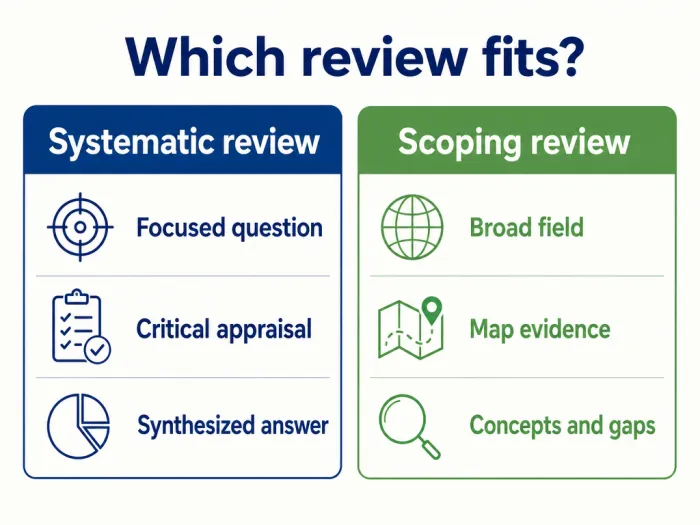
A systematic review and a scoping review both use transparent, reproducible methods, but they answer different kinds of research questions. A systematic review is usually the better choice when you need a focused answer about effects, associations, experiences, diagnostic accuracy, or another precisely defined outcome. A scoping review is designed to map a broader field, clarify concepts, describe how research has been conducted, and identify evidence gaps.
The decision should be driven by the purpose of the review, not by the number of available papers or the assumption that one method is easier than the other.
Quick answer: Choose a systematic review when your question requires a focused, critically appraised synthesis. Choose a scoping review when you first need to understand the range, characteristics, terminology, or boundaries of the available evidence.
The central difference: synthesis versus mapping
The two approaches overlap in their use of a protocol, structured searching, explicit eligibility criteria, documented screening, and transparent reporting. Their objectives, however, are not interchangeable.
A systematic review brings together evidence that can answer a defined research question. It commonly evaluates the trustworthiness of included studies and examines what their combined findings support. Its synthesis may be statistical, as in a meta-analysis, or narrative, thematic, qualitative, or mixed-methods.
A scoping review examines the extent and nature of evidence across a potentially broad or diverse field. It can document study designs, populations, definitions, interventions, outcomes, geographical coverage, or research gaps. Formal critical appraisal may be included when it serves the review objective, but it is not always required.
Mapping the existence of research is different from determining what that research demonstrates.
Systematic review vs scoping review at a glance
| Criterion | Systematic review | Scoping review |
|---|---|---|
| Primary purpose | Answer a focused question by synthesizing relevant evidence | Map the range, characteristics, concepts, or gaps in a body of evidence |
| Typical question | What is the effect, association, accuracy, prevalence, or experience? | What evidence exists, how is the topic defined, and how has it been studied? |
| Scope | Usually narrow and precisely defined | Usually broad, exploratory, or conceptually diverse |
| Study designs | Selected according to the question and planned synthesis | Often varied, including multiple methods and evidence types |
| Critical appraisal | Normally an important part of interpreting the findings | Optional in some frameworks, depending on the objective |
| Typical output | An evidence synthesis with conclusions qualified by study quality and certainty | A descriptive map, taxonomy, evidence chart, or gap analysis |
| Meta-analysis | Possible when studies and data are sufficiently comparable | Generally not the main purpose |
When a systematic review fits your question
A systematic review is appropriate when the intended conclusion depends on comparing, evaluating, or integrating findings from eligible studies. The question should be sufficiently focused to support defensible inclusion criteria and a meaningful synthesis.
Questions about intervention effects
Effectiveness questions often specify a population, an intervention, a comparator, and one or more outcomes. For example:
Among first-year university students, do structured peer-mentoring programs improve retention compared with usual student support?
This question sets clear boundaries and invites an assessment of results rather than a simple inventory of available publications.
Questions beyond effectiveness
Systematic reviews are not limited to randomized trials or healthcare interventions. They can synthesize:
- associations between exposures and outcomes;
- prevalence or incidence estimates;
- diagnostic or predictive accuracy;
- qualitative evidence about experiences and perspectives;
- implementation barriers and facilitators;
- economic or policy evidence.
The question framework should match the evidence being sought. PICO is useful for many intervention questions, but frameworks such as PICo, PECO, and SPIDER may fit qualitative, exposure, or mixed-methods questions better. Selecting suitable research resources should likewise follow the question and intended evidence type.
What the method should deliver
A well-designed systematic review does more than collect studies. It should explain how the evidence was found, why each study was eligible, how limitations were assessed, how findings were combined, and how much confidence readers can place in the conclusion.
A meta-analysis is not mandatory for a systematic review. If studies differ substantially in their populations, methods, measures, or contexts, a structured narrative or qualitative synthesis may be more appropriate.

When a scoping review is the better choice
A scoping review is useful when a field is broad, fragmented, emerging, or described with inconsistent terminology. Instead of forcing heterogeneous evidence into a narrowly defined conclusion, it creates an organized account of what has been studied.
Mapping an emerging field
Consider this question:
How has generative artificial intelligence been used to support feedback in higher education?
The relevant literature could include experimental studies, qualitative interviews, design reports, policy analyses, and conference proceedings. A scoping review could classify the tools, educational settings, purposes, reported outcomes, and methodological approaches without treating unlike evidence as directly comparable. This mapping function is particularly valuable in interdisciplinary sciences, where terminology and methods may vary between fields.
Clarifying concepts and definitions
A scoping review can identify how researchers define a concept, whether competing definitions exist, and which indicators or measurement tools are used. This is valuable when inconsistent terminology makes a focused synthesis premature.
Identifying evidence gaps
Scoping reviews can reveal where evidence is concentrated and where it is sparse. A map might show, for example, that most studies come from a small group of countries or focus on short-term outcomes.
Absence from the included literature should nevertheless be described carefully. A review can identify a gap in the evidence it located; it cannot automatically prove that no relevant work exists anywhere.
A five-question decision framework
- What must the review ultimately produce? If you need an answer about effects, relationships, experiences, or accuracy, lean toward a systematic review. If you need a map of the field, consider a scoping review.
- How focused is the question? A tightly bounded question generally supports systematic synthesis. A broad question covering many concepts, methods, or evidence types often supports scoping.
- Is critical appraisal essential to the conclusion? If conclusions must depend on risk of bias or methodological quality, a systematic review is usually more suitable.
- Can the expected studies be synthesized meaningfully? Diversity alone does not prevent a systematic review, but the planned synthesis must remain coherent and answer the stated question.
- Who will use the result? Decision-makers may need an evaluated answer, while researchers entering an emerging field may first need a vocabulary, classification, and evidence map.
Practical rule:
- Use a systematic review to determine what the evidence indicates about a defined question.
- Use a scoping review to determine what evidence exists and how that evidence is structured.
Common selection mistakes
Choosing a scoping review because it appears easier
A scoping review may cover more databases, broader eligibility criteria, and more varied evidence than a focused systematic review. Screening and charting can therefore be substantial. The method should be selected for its objective, not as a shortcut around critical appraisal or synthesis.
Calling every structured literature search a systematic review
A database search alone does not make a review systematic. The label implies predefined methods, transparent eligibility decisions, reproducible searching, documented screening, and an appropriate synthesis.
Assuming a systematic review requires meta-analysis
Meta-analysis is one possible synthesis method. It should only be used when combining the data is scientifically and statistically defensible. A systematic review can remain valuable without pooled numerical estimates.
Using a broad question but promising a definitive conclusion
A broad map of heterogeneous evidence usually cannot establish which intervention works best or what policy should be adopted. Conclusions must remain aligned with the review design and the strength of the included evidence.
Changing review type after seeing convenient results
Reviewers should define the objective and method before full screening whenever possible. If the question or method changes, the change should be justified and documented rather than hidden.
Protocol, searching, appraisal, and reporting
Whichever approach you choose, write a review protocol before conducting the full review. It should define the rationale, objectives, eligibility criteria, information sources, search process, screening procedure, data fields, and synthesis or mapping plan.
Search strategy
Both review types require a search strategy proportionate to the question. Scoping does not mean casual searching. Relevant databases, terminology variants, date or language limits, grey literature, and supplementary search methods should be considered and reported. Reviewing recent work can also help researchers recognize the vocabulary used within a developing field, although eligibility decisions must still follow the protocol.
Study selection and data extraction
Eligibility criteria should be tested on a sample of records before full screening. Extraction forms should also be piloted. In a systematic review, extracted data usually support appraisal and synthesis. In a scoping review, data charting often captures publication characteristics, concepts, methods, settings, and evidence types.
Critical appraisal
Systematic reviews normally assess risk of bias or methodological limitations using tools appropriate to the included study designs. Scoping reviews may conduct appraisal, but authors should explain why it is needed and how it affects the interpretation.
Reporting framework
PRISMA 2020 provides a reporting framework for systematic reviews, while PRISMA-ScR addresses reporting needs specific to scoping reviews. These are reporting guidelines rather than substitutes for a complete methodological framework.
Transparent reporting cannot repair a poorly matched review design. The question, method, appraisal strategy, and intended output must be aligned from the beginning.
Pre-protocol checklist
- Write the review objective in one sentence.
- State the decision, knowledge need, or audience the review will serve.
- Decide whether the intended output is an evaluated answer or an evidence map.
- Build a question framework suited to the topic and evidence type.
- Draft explicit inclusion and exclusion criteria.
- Estimate the likely volume and diversity of records with preliminary searches.
- Choose databases and supplementary sources for substantive reasons.
- Decide whether critical appraisal is required and how it will be used.
- Define the planned synthesis, classification, or mapping outputs.
- Select the relevant methodological and reporting guidance.
- Pilot screening and extraction forms.
- Document protocol amendments throughout the project.
Mini FAQ
Can a scoping review include critical appraisal?
Yes. Appraisal can be included when it supports the review objective, but it is not universally required for scoping reviews. Authors should state why appraisal was undertaken and avoid implying that a descriptive map provides the same certainty as an evaluative synthesis.
Can a systematic review have a broad question?
It can address a complex or multifaceted question, but its boundaries and synthesis plan must remain coherent. If the main objective is to catalogue many concepts, methods, populations, and evidence types, a scoping review may fit better.
Is a meta-analysis stronger than a systematic review without one?
Not automatically. A pooled estimate is useful only when the included data can be combined appropriately. An unsuitable meta-analysis can be more misleading than a transparent narrative synthesis.
Can a scoping review determine whether an intervention works?
It can describe studies that evaluated an intervention, but establishing effectiveness generally requires focused eligibility criteria, critical appraisal, and an appropriate synthesis. That objective usually points to a systematic review.
Should a scoping review be completed before every systematic review?
No. Preliminary searching and familiarity with the field may be enough to justify a focused systematic review. A separate scoping review is helpful when concepts, boundaries, evidence types, or terminology need formal mapping first.
What if the question still fits both approaches?
Return to the intended conclusion. If readers need to know what the evidence supports, choose a systematic review. If they need to know what evidence is available and how it is organized, choose a scoping review. A review methodologist or information specialist can help test the question before the protocol is finalized.