

The Methods section explains how a study was designed, conducted, and analyzed. Reading it carefully helps you decide whether the findings are credible, whether the authors answered their research question, and whether the work could be repeated.
You do not need to be a statistician to evaluate research methods. Start with the study’s logic, then examine the participants or data, measurements, procedures, and analysis. This guide provides a practical framework that works across many scientific disciplines.
Why the Methods section matters
The abstract tells you what the researchers found. The Methods section tells you how they produced those findings. That distinction matters because an interesting result can still rest on a weak design, an unsuitable sample, or measurements that do not represent the concept under investigation.
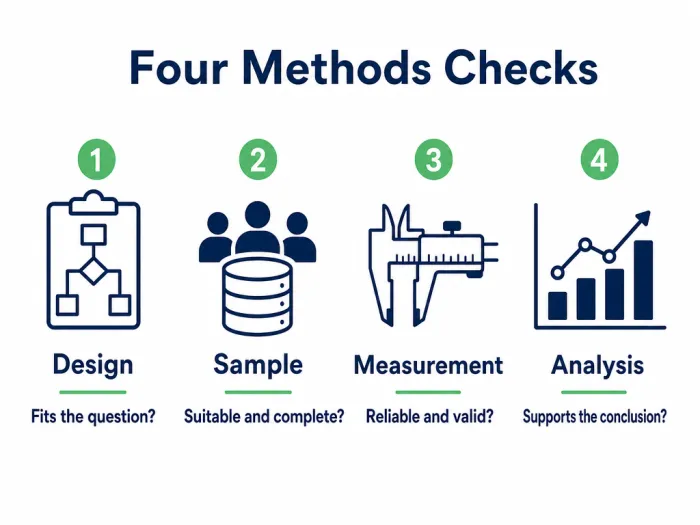
A strong Methods section should allow you to answer four basic questions:
- Was the study design appropriate for the research question?
- Were the participants, materials, or datasets suitable?
- Were the variables measured consistently and meaningfully?
- Was the analysis capable of supporting the conclusions?
Methods also establish the boundaries of a paper. A study involving one population, location, period, or experimental setting may not apply automatically to other contexts.
A compelling result is not necessarily a credible result: its value depends on how the study was designed and conducted.
Begin with the research question and study design
Before reviewing procedural details, identify the question the paper is trying to answer. If it is not stated explicitly in the Methods section, look near the end of the introduction. The distinction between a research question and hypothesis can help you identify the study’s underlying question and its testable prediction.
Next, determine the overall design. Common designs include:
- Randomized experiment: participants or units are assigned to different conditions using a random process.
- Observational study: researchers measure characteristics or outcomes without assigning an intervention.
- Cross-sectional study: data are collected at one point or during a limited period.
- Longitudinal study: the same units or population are examined over time.
- Case-control study: groups with and without an outcome are compared retrospectively.
- Cohort study: a defined group is followed to observe exposures and outcomes.
- Qualitative study: interviews, observations, documents, or other non-numerical materials are analyzed for patterns and meaning.
- Systematic review or meta-analysis: existing studies are selected and synthesized using predefined criteria.
The design should match the question. A descriptive survey may estimate how common an opinion is, but it usually cannot establish that one factor caused another. An experiment may provide stronger evidence about causation, although its value still depends on allocation, controls, measurement quality, and implementation.
Examine the sample, participants, or data source
Find out what was studied and how it was selected. Depending on the discipline, the units may be people, animals, organizations, documents, biological samples, computer simulations, or existing records.
Selection and eligibility
Look for inclusion and exclusion criteria. These rules define who or what could enter the study. Consider whether they are scientifically justified or whether they produce an unusually narrow sample.
Also identify the recruitment or sampling method. A probability sample is selected through a random procedure, while a convenience sample relies on readily available participants or data. Convenience sampling is not automatically invalid, but it can limit how broadly the findings apply.
Sample size and missing data
A sample should be large enough to address the stated question, but size alone does not guarantee quality. A very large biased sample can produce precise estimates of the wrong quantity. Conversely, a small study may be useful for exploratory or qualitative work when its purpose is clearly defined.
Check whether the authors explain how the sample size was chosen. In quantitative research, this may involve a power calculation, an expected effect size, a precision target, or the amount of available data. Note how many units entered the study, completed each stage, and were included in the final analysis.
Missing data deserve particular attention. Ask how much information was missing, why it may have been missing, and how the researchers handled it. Simply removing incomplete records can distort results when the missingness is related to participant characteristics or outcomes.
Identify variables and evaluate their measurement
A variable is any characteristic that can differ across observations. Methods sections often describe outcomes, predictors, exposures, interventions, control variables, and potential confounders.
Operational definitions
An operational definition explains how an abstract concept was turned into something observable. For example, “academic performance” could mean an examination score, a grade-point average, course completion, or a self-reported assessment. These measures are related, but they are not interchangeable.
Ask whether each measure captures the concept it is intended to represent. Pay attention to thresholds and categories: converting a continuous measurement into “high” and “low” groups may simplify interpretation while discarding meaningful information.
Reliability, validity, and measurement bias
Reliability concerns consistency. Would the instrument or coding process produce similar results under comparable conditions? Validity concerns whether the procedure measures what it claims to measure.
Look for validated instruments, calibration procedures, repeated measurements, coding rules, and agreement checks between observers. Self-reported information can be useful, but it may be affected by memory, interpretation, or a desire to provide socially acceptable answers.
A precise measurement is not automatically a valid measurement. Consistency matters, but the method must also represent the intended concept.
Reconstruct what the researchers actually did
Read the procedure in chronological order. Try to reconstruct the path from recruitment or data collection to the final dataset. If you cannot explain that sequence in plain language, reread the relevant paragraphs and note any missing steps.
For experiments, check:
- How participants or units were allocated to groups
- Whether a control or comparison group was used
- Whether participants, researchers, or outcome assessors were blinded
- Whether all groups were treated similarly apart from the intervention
- How adherence, deviations, and adverse events were recorded
For observational research, identify how exposures and outcomes were recorded, when measurements occurred, and which alternative explanations were considered. For qualitative studies, examine how interviews or observations were conducted, recorded, coded, and interpreted.
In computational work, look for software versions, parameter settings, preprocessing decisions, model specifications, random seeds, validation procedures, and access to code or data. The description should reveal consequential choices, even when full reproduction requires specialist resources.
Read the statistical or analytical plan
You do not need to understand every formula on the first pass. Focus initially on whether the analysis follows logically from the question, design, and type of data.
| Methodological element | What to look for | Question to ask |
|---|---|---|
| Outcome | Primary and secondary outcomes | Was the main outcome defined before analysis? |
| Comparison | Groups, conditions, periods, or models | Does the comparison address the research question? |
| Adjustment | Confounders and covariates | Why were these variables included or omitted? |
| Uncertainty | Confidence intervals, credible intervals, or equivalent measures | How precise are the estimates? |
| Robustness | Sensitivity checks and alternative specifications | Do reasonable analytical choices change the result? |
Do not treat a p-value as a complete verdict. Statistical significance does not tell you whether an effect is large, important, unbiased, or applicable outside the sample. Examine effect sizes and uncertainty intervals where they are available.
Be alert to multiple testing. When researchers test many outcomes, subgroups, or model specifications, some apparently notable results can occur by chance. A clear Methods section should distinguish planned analyses from exploratory ones and explain any correction or validation strategy used.

Check bias, ethics, and reproducibility
Every design has limitations. Your task is not to find a flawless paper, but to determine whether important risks were anticipated, reduced, and reported transparently.
Common sources of bias
- Selection bias: the included sample differs systematically from the target population.
- Measurement bias: variables are measured differently across groups or with a systematically inaccurate tool.
- Confounding: a third factor is related to both the exposure and outcome, creating a misleading association.
- Attrition bias: withdrawals or missing follow-up differ between groups.
- Researcher degrees of freedom: flexible choices about exclusions, outcomes, or models influence the reported result.
For studies involving people or animals, look for an ethics review or approval statement where applicable, along with consent procedures and protections for privacy or welfare. Ethical approval is important, but it does not by itself demonstrate that the design or analysis is strong.
Reproducibility is easier to assess when authors provide protocols, preregistration records, materials, data, or code. Access may be restricted for legitimate privacy, legal, or commercial reasons; in that case, the paper should explain the restriction and any controlled access process.
The goal is not to find a perfect study, but to understand how its methodological limitations affect interpretation.
Use a repeatable reading checklist
On a first reading, aim to understand the design rather than inspect every technical detail. Return for a closer review if the paper is central to your research or decisions.
- State the research question in one sentence.
- Name the study design.
- Identify the population, sample, material, or dataset.
- Record the inclusion and exclusion criteria.
- Find the primary outcome or central object of analysis.
- Explain how the main variables were measured.
- Reconstruct the procedure in chronological order.
- Identify the principal comparison and analytical method.
- Check how missing data, exclusions, and deviations were handled.
- List the most plausible sources of bias or confounding.
- Look for ethics, registration, data, code, and protocol statements.
- Decide which populations and settings the results could reasonably apply to.
Keep your notes connected to the exact page, paragraph, table, or supplementary file. A structured literature review matrix can make comparisons across papers easier.
Warning signs that deserve closer examination
A warning sign does not automatically invalidate a study. It indicates that you should seek clarification in the paper, supplementary materials, protocol, or cited methodological references.
- The study design is difficult to identify.
- Eligibility criteria or recruitment procedures are missing.
- The sample changes between sections without explanation.
- The primary outcome is not clearly defined.
- Measurements are described vaguely or without units.
- Important exclusions appear to have been decided after results were known.
- Many subgroup analyses are reported without a prior rationale.
- Missing data are substantial but barely discussed.
- The analysis does not account for the study design or data structure.
- The procedure lacks enough detail to understand what was done.
- The conclusions imply causation even though the design supports only association.
If a method is unfamiliar, consult a suitable textbook, reporting guideline, or specialist reference rather than judging it only by its name. Selecting appropriate research resources can also help you investigate unfamiliar techniques.
A practical final test
After reading the Methods section, try to explain the study to another person without using the authors’ technical wording. Describe who or what was studied, what was measured, what comparison was made, how the data were analyzed, and which weaknesses could affect interpretation.
If you can do that accurately, you are ready to read the results critically. If you cannot, return to the procedure, variables, and analytical plan before accepting the paper’s claims.
You understand a Methods section when you can reconstruct the study, identify its main analytical choices, and explain its limitations in plain language.
Mini FAQ
Should I read the Methods section before the Results?
Often, yes. Reading the Methods first helps you understand what the reported numbers represent and prevents the most striking result from shaping your evaluation prematurely. A practical order is abstract, introduction, Methods, Results, and discussion.
How can I evaluate methods outside my field?
Start with universal questions about design, sampling, measurement, comparison, uncertainty, and bias. Mark specialist techniques for later review. You can understand the logic of a study without immediately mastering every technical procedure.
Does a large sample mean the study is reliable?
No. A large sample can improve precision, but it does not correct biased selection, poor measurement, uncontrolled confounding, or an unsuitable design.
What if important details appear only in supplementary materials?
Consult them when the paper matters to your work. Modern Methods sections are often shortened by publication limits, while protocols, appendices, codebooks, and analysis plans may contain essential details.
Can an observational study prove causation?
Observational evidence can contribute to a causal argument, but an association alone is not proof of causation. Assess temporality, confounding, measurement quality, alternative explanations, robustness, and supporting evidence from other designs.
What should I do when the method remains unclear?
Write down the precise missing information and check appendices, registrations, cited protocols, and related papers. If the detail is essential and unavailable, treat that uncertainty as part of your appraisal rather than filling the gap with an assumption.