

A preprint can provide early access to valuable research, but it has not necessarily undergone formal peer review. A peer-reviewed article has passed a journal’s evaluation process, yet that does not guarantee that every method, result, or conclusion is correct.
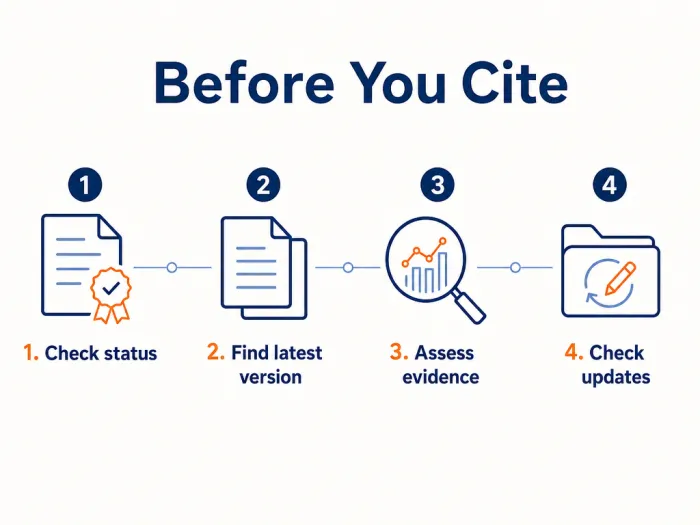
Before citing either version, confirm its publication status, identify the most recent version, and assess whether the evidence supports the claim you plan to make.
Preprint vs peer-reviewed article: the practical difference
A preprint is a manuscript shared publicly before completion of a journal’s formal peer-review process. Authors often post preprints to communicate findings quickly, invite feedback, establish priority, or make research accessible while journal evaluation is underway.
A peer-reviewed article has been evaluated through a journal’s editorial process. Depending on the journal, this may involve assessment by an editor and one or more independent reviewers, followed by revisions. The published article may differ substantially from the original preprint.
The distinction concerns publication status, not an automatic ranking of truth. A carefully prepared preprint may contain strong evidence, while a peer-reviewed paper may still have methodological limitations, reporting errors, or conclusions that later studies fail to reproduce.
| Question | Preprint | Peer-reviewed article |
|---|---|---|
| Formal journal review completed? | Usually no | Yes, according to the journal’s process |
| Can the text change? | Yes; revised preprint versions may be posted | Yes; corrections, updates, or retractions remain possible |
| Speed of availability | Often rapid | Usually slower because evaluation takes time |
| Safe to accept without appraisal? | No | No |
| Best citation target when both exist | Usually not preferred | Usually the version of record |
First, verify what you are actually reading
Do not infer publication status from a polished PDF, a DOI, an academic logo, or inclusion in a search platform. Instead, inspect the document and its record directly.
Look for an explicit status label
Preprint servers commonly identify manuscripts as “preprint,” “working paper,” or “not peer reviewed.” Some also display a warning that the findings should not guide clinical practice or public policy without further evaluation.
On a journal website, look for a volume, issue, article number, publication history, journal DOI, and a clear article type. Be aware that accepted manuscript, author accepted manuscript, and early view do not necessarily mean the same thing. An accepted manuscript has generally passed peer review but may not yet have undergone final copy-editing and typesetting.
Confirm the venue and editorial process
Review the journal’s editorial or peer-review policy. A statement that a paper is “published” is not enough to establish how it was evaluated. Editorials, letters, news items, conference abstracts, protocols, and commentaries may follow different review procedures from original research articles.
Database indexing can help locate a record, but it should not be treated as proof that a specific document received a particular form of peer review.
Check whether a newer or published version exists
Preprints may have several revisions, each with different analyses, figures, author lists, or conclusions. Before citing one, check the version number and posting date. Then search the title, authors, and DOI to determine whether the manuscript was later published by a journal.
When both versions exist, compare them rather than assuming they are identical. Important changes can include:
- a larger or smaller study sample;
- revised statistical analyses;
- different primary or secondary outcomes;
- additional limitations or sensitivity checks;
- changes in the strength of the conclusions;
- updated authorship, funding, or conflict-of-interest statements.
In most academic contexts, cite the final journal version when it is available and relevant. Do not silently combine details from two versions under one citation.
Cite the preprint separately if you are discussing its publication history, comparing versions, or relying on material that appears only in that version.
Use persistent identifiers carefully
A DOI helps identify and retrieve a research object, but it does not by itself prove peer review. Preprints, datasets, reports, and journal articles can all receive persistent identifiers. Follow the DOI and inspect the resulting record, document type, publisher, dates, and links to related versions.
Evaluate the evidence, not only the label
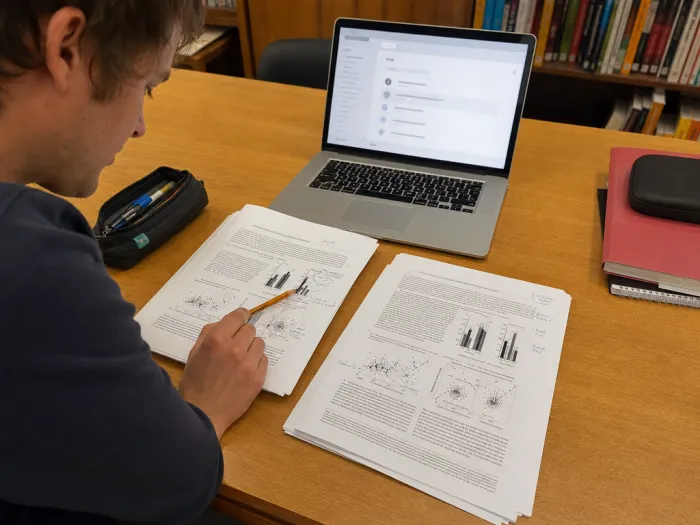
Peer review is a quality-control process, not a certification that a result is true. Whether you are reading a preprint or a journal article, evaluate the research question, design, methods, analysis, and interpretation.
Match the study design to the claim
Ask what the study can reasonably establish. An observational association does not by itself demonstrate causation. A small exploratory study should not support a broad claim about an entire population. A simulation depends on its assumptions, while a survey depends on sampling and measurement quality.
If the article makes causal claims, examine whether the design, comparison groups, timing, controls, and analytical strategy justify them. The distinction between correlation and causation provides a useful framework for evaluating such claims.
Read the methods and results together
Check how participants, observations, or datasets were selected. Identify exclusions, missing data, outcome definitions, model assumptions, and whether the analysis was planned in advance. Effect sizes and uncertainty intervals are often more informative than a binary statement that a result was “statistically significant.”
The methods section should contain enough information to understand what was done and, ideally, to support independent scrutiny. Also check whether data, code, materials, registration records, or study protocols are available.
Test the conclusion against the reported results
Compare the abstract and discussion with the tables, figures, and limitations. Watch for conclusions that extend beyond the studied population, outcome, time period, or experimental conditions.
A paper may report a statistically detectable difference that is too small or uncertain to be practically meaningful.
Check credibility, transparency, and post-publication status
Authorship and affiliation provide context, but neither prestige nor institutional reputation replaces critical appraisal. Review the paper’s transparency statements and its status after publication.
- Authorship: Are the authors and their affiliations clearly identified?
- Funding: Is financial support disclosed?
- Competing interests: Are relevant personal or institutional interests reported?
- Ethics: Where applicable, is ethics approval or informed consent described?
- Data and code: Are availability statements present and usable?
- Registration: For applicable study types, is there a protocol or registration record?
- Corrections: Has the publisher attached an erratum, expression of concern, or retraction notice?
A correction does not automatically invalidate an article; its significance depends on what changed. A retraction, however, is a major warning and must be disclosed if the work is discussed. Also examine substantive expert criticism, replication attempts, and subsequent evidence rather than relying only on social-media reactions or citation counts.
Reproducibility and replicability answer related but distinct questions when research findings are checked.
A citation checklist you can use before submitting
Run through this checklist for every source that materially supports your argument:
- Have I confirmed whether the document is a preprint, accepted manuscript, or journal article?
- Have I checked the version number and date?
- Did I search for a newer revision or a published version?
- Am I citing the exact version I actually read?
- Does the cited source directly support the sentence attached to it?
- Is the study design capable of supporting that type of claim?
- Have I examined the methods, results, limitations, and disclosures?
- Have I checked for corrections, expressions of concern, or retractions?
- Have I described preliminary findings as preliminary?
- Would a review, guideline, dataset, or primary source support the point more appropriately?
- Does my required citation style allow or specify a format for preprints?
When citing a preprint, clearly label it as such in the text or reference entry when the citation style permits. Include the author list, title, repository or server, year, version where relevant, and persistent identifier.
Never format a preprint in a way that could mislead readers into believing it is a peer-reviewed journal article.
When is it appropriate to cite a preprint?
Citing a preprint can be appropriate when research is emerging, the journal version does not yet exist, rapid communication is important, or the preprint itself is the object of analysis. Preprints can also help document the evolution of an idea or provide access to methods and results before formal publication.
Use greater caution when a claim could affect health decisions, financial choices, safety, or public policy. In these contexts, avoid presenting one unreviewed study as settled knowledge. Explain the uncertainty, seek corroborating evidence, and prefer authoritative guidance for practical recommendations.
A preprint may be a useful source, but it should not be chosen merely because it is recent or supports a preferred conclusion. Place it within the wider literature. A literature review matrix can help compare designs, samples, outcomes, limitations, and publication status across multiple sources. Appropriate research resources should also be selected according to the claim being supported.
Mini FAQ
Does a DOI mean that an article is peer reviewed?
No. A DOI is a persistent identifier. It can be assigned to preprints, datasets, reports, conference outputs, and peer-reviewed articles. Verify the document type and editorial status separately.
Is every article on a journal website peer reviewed?
Not necessarily. Journals may publish editorials, corrections, letters, news, book reviews, protocols, and other content under different editorial procedures. Check the article type and the journal’s policy.
Should I replace a preprint citation when the journal article appears?
Usually, yes, if the published article is the relevant version of record. First compare the versions to ensure that the published paper still supports your statement. Retain the preprint citation when the distinction between versions matters.
Can a peer-reviewed article still be wrong?
Yes. Reviewers may miss errors, data may be incomplete, assumptions may fail, and later evidence may alter the conclusion. Peer review reduces some risks but does not eliminate the need for critical appraisal.
Can I cite a preprint in a thesis or journal manuscript?
Often, but rules vary by institution, journal, discipline, and citation style. Check the applicable author guidelines and identify the source clearly as a preprint.
What should I do if the preprint and published article disagree?
Determine which methods, data, and conclusions changed. Cite the version that supports the specific statement you are making, and explain the discrepancy if it is relevant to your argument. Do not treat the two documents as interchangeable.