

Research limitations are constraints, weaknesses, or uncertainties that may affect a study’s findings or their interpretation. Research delimitations are the boundaries the researcher intentionally sets to keep the project focused and feasible.
The key distinction is control: limitations are usually conditions you cannot fully eliminate, while delimitations result from deliberate choices about the population, variables, setting, period, or methods.
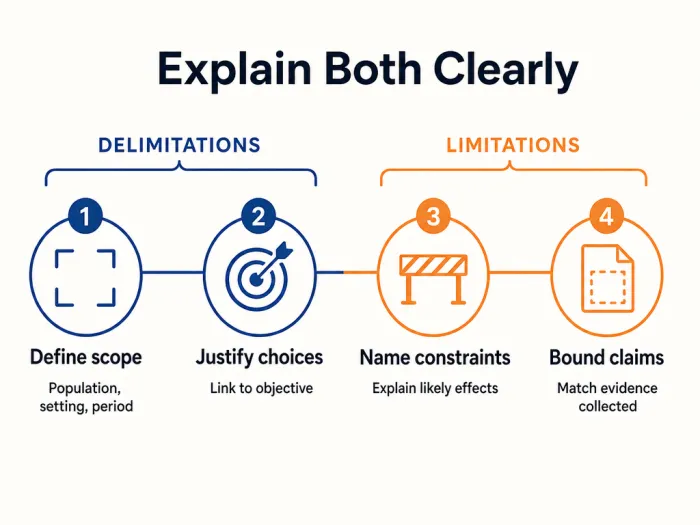
Explaining both clearly helps readers understand what a study can support—and what it does not attempt to establish.
Limitations vs delimitations: the key difference
| Point of comparison | Limitations | Delimitations |
|---|---|---|
| Meaning | Constraints, weaknesses, or uncertainties affecting the study | Boundaries intentionally established by the researcher |
| Level of control | Often outside the researcher’s full control | Generally within the researcher’s control |
| Main purpose | Qualify the strength, interpretation, or transferability of findings | Define the study’s scope and maintain focus |
| Typical examples | Missing data, response bias, measurement error, or limited access | One age group, one location, selected variables, or a fixed date range |
| Question answered | What could weaken or qualify the conclusions? | What did the researcher intentionally include or exclude? |
Terminology and placement can vary among disciplines and institutions. If your department provides a dissertation template or research handbook, follow its definitions and required structure.
What are research limitations?
Research limitations are features of a study that may restrict the conclusions drawn from its evidence. They do not automatically invalidate the research. Every study operates under practical, methodological, and conceptual constraints; the goal is to identify the relevant ones and explain their consequences accurately.
Common types of limitations
- Sampling limitations: a small sample, nonresponse, self-selection, attrition, or limited representation of the target population.
- Measurement limitations: imperfect instruments, self-reported behavior, ambiguous questions, or inconsistent data collection.
- Design limitations: an observational or cross-sectional design that cannot establish temporal order or causal effects.
- Data limitations: missing records, incomplete variables, inconsistent definitions, or reliance on an existing dataset.
- Contextual limitations: findings produced in a particular institution, region, culture, or period.
- Researcher-related limitations: possible interpretive bias or limited access to participants, documents, or settings.
How to discuss a limitation
A useful limitation statement contains three elements:
- Name the constraint precisely.
- Explain its likely effect on the evidence or interpretation.
- Describe the response, such as a mitigation measure or a cautious conclusion.
Example: Because participants volunteered for the survey, the sample may overrepresent people with a strong interest in the topic. The findings should therefore not be treated as prevalence estimates for the entire population. To reduce overgeneralization, results are reported for the surveyed group and interpreted alongside the sample characteristics.
This wording is more informative than simply saying, “The study had a small sample.” It tells the reader why the issue matters and how it affects the claim.

What are research delimitations?
Research delimitations define the scope chosen for the study. Researchers create these boundaries when converting a broad topic into a manageable research project. A delimitation may specify who or what is studied, which concepts are measured, where data are collected, or what period the analysis covers.
Common types of delimitations
- Population: including adults, first-year students, managers, or another defined group.
- Geographic scope: focusing on one city, country, institution, or type of community.
- Time frame: examining data from selected years or conducting fieldwork during a defined period.
- Variables: studying particular factors while excluding others that fall outside the research question.
- Method: choosing interviews, a survey, an experiment, or document analysis rather than combining every possible approach.
- Theoretical scope: applying one framework or set of concepts to guide the analysis.
How to justify a delimitation
Do not merely state what was excluded. Connect each important boundary to the research objective, design, feasibility, or available evidence.
Example: The study is delimited to full-time undergraduate students at one urban university because its objective is to examine experiences within that institutional setting. Part-time and postgraduate students are outside the scope because their schedules and academic conditions may differ substantially.
The statement identifies the population, gives a reason for the choice, and avoids implying that the findings necessarily describe students elsewhere.
How a delimitation can lead to a limitation
The categories are related rather than completely separate. An intentional decision can create a later constraint on interpretation.
For example, a researcher may deliberately collect data at one university. That is a delimitation because the setting was selected intentionally. The resulting uncertainty about whether the findings apply to other universities is a limitation.
Similarly, using a cross-sectional survey may be an intentional methodological boundary. However, the inability to determine whether one variable preceded another is a limitation of the resulting design.
A single study feature may be both a delimitation and a source of limitation, depending on whether the discussion concerns the original choice or its effect on interpretation.
Examples across research designs
| Research design | Possible delimitation | Possible limitation |
|---|---|---|
| Survey | Adults employed full time in one sector are included. | Self-reported responses may be affected by recall or social-desirability bias. |
| Qualitative interviews | The analysis focuses on participants’ experiences rather than estimating prevalence. | Interpretation may be influenced by the interview context and the researcher’s analytical decisions. |
| Experiment | One intervention and one primary outcome are tested. | A controlled setting may not reproduce all conditions encountered in ordinary practice. |
| Secondary-data study | The study examines records from a specified period. | The dataset may omit variables needed to assess alternative explanations. |
| Literature review | Only defined databases, languages, dates, or publication types are searched. | Relevant studies may be missed because of indexing, terminology, access, or publication bias. |
Where to explain limitations and delimitations
Placement depends on the required format, but the two concepts often appear in different parts of a research report.
- Introduction or proposal: state major delimitations when defining the study’s scope.
- Methods section: report operational boundaries such as eligibility criteria, setting, time frame, variables, and methodological choices.
- Discussion: explain limitations after presenting the results, because their significance is clearer in relation to the findings.
- Final section: briefly connect the most important constraints to the appropriate scope of the final claims.
A proposal may describe anticipated limitations in the future tense. A completed paper should discuss the constraints actually encountered and their observed or plausible implications. The methods section should provide the information readers need to identify important design boundaries.
A practical writing framework
Template for delimitations
This study focuses on [population, setting, variables, or period]. It includes [scope] and excludes [out-of-scope elements]. These boundaries were selected because [connection to the research question, design, or feasibility]. Accordingly, the study addresses [specific objective] rather than [broader objective].
Template for limitations
This study is limited by [specific constraint]. This may affect [measurement, interpretation, generalizability, transferability, or causal inference] because [reason]. The study addresses this concern by [mitigation or transparent reporting]. Therefore, the findings should be interpreted as [appropriately bounded claim].
Combined example
The study is delimited to employees in medium-sized technology firms within one region, reflecting its focus on that local labor market. This boundary excludes workers in other sectors and regions. In addition, the voluntary survey may be affected by self-selection, as employees with stronger views may have been more likely to participate. The results describe associations within the responding sample and should not be interpreted as causal estimates or as representative of all employees.
A simple structure to follow
When writing the section, move from the study’s intended scope to the constraints affecting its findings:
- Define the population, setting, variables, methods, and period.
- Identify which boundaries were intentional.
- Justify those choices using the research objective.
- Name the material constraints encountered.
- Explain how each constraint affects interpretation.
- State the appropriate boundary of the final claims.
Common mistakes to avoid
- Using the terms interchangeably: clarify whether the feature was an intentional scope decision or a constraint affecting interpretation.
- Listing issues without consequences: explain how each important limitation changes what readers can conclude.
- Calling every choice a weakness: a narrow scope can be appropriate when it matches a focused research question.
- Making vague disclaimers: replace phrases such as “time was limited” with the specific effect on recruitment, measurement, or analysis.
- Claiming causation from association: design limitations matter when interpreting correlation and causation.
- Overgeneralizing: avoid extending findings beyond the studied population or setting without supporting evidence.
- Being defensive: transparent discussion demonstrates methodological judgment; it is not an admission that the study has no value.
- Adding generic limitations: include only constraints that genuinely apply and materially affect interpretation.
Checklist for explaining both clearly
- Have you defined the population, setting, variables, and time frame?
- Have you identified which boundaries were intentional?
- Is each major delimitation connected to the research objective?
- Have you identified constraints that affected the data or analysis?
- Does each limitation include a likely consequence?
- Have you described mitigation without claiming that it removed all uncertainty?
- Are causal claims consistent with the research design?
- Are conclusions restricted to the evidence actually collected?
- Have you followed your institution’s preferred terminology and placement?
Before finalizing the discussion, compare it with the logic of the research question and hypothesis and the information reported in the methods.
Delimitations describe the territory the study was designed to examine. Limitations describe the conditions that qualify what the study found.
Mini FAQ
Is a small sample a limitation or a delimitation?
It depends on how the sample size arose. Restricting recruitment to a defined group may be a delimitation. Failing to reach the planned sample because of low participation is a limitation. In either case, explain the sample’s effect on precision and the scope of the conclusions.
Are delimitations weaknesses?
Not necessarily. Delimitations are often necessary to create a coherent, feasible study. They become problematic when they do not align with the research question or when conclusions extend beyond the chosen scope.
Do limitations make a study unreliable?
No. A limitation qualifies what the evidence can support. Reliability concerns consistency of measurement, while limitations can involve sampling, design, data, context, or interpretation. Transparent reporting allows readers to evaluate the findings appropriately.
Should researchers explain how they addressed each limitation?
Researchers should describe relevant mitigation measures when they were actually used. They should not claim that a measure completely removed a limitation unless the evidence supports that conclusion.
Can generalizability be a limitation?
Yes. Findings from a narrow or nonrepresentative sample may not generalize statistically to a wider population. In qualitative research, it may be more appropriate to discuss contextual relevance or transferability rather than statistical generalization.
How many limitations should a paper include?
There is no universal number. Prioritize the limitations that materially affect the main findings, avoid repetitive disclaimers, and follow any requirements set by the journal, supervisor, or institution.